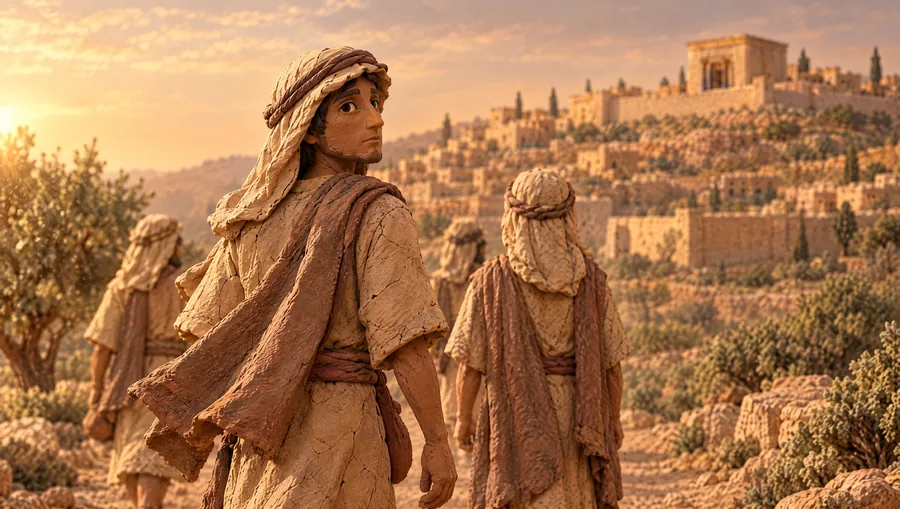
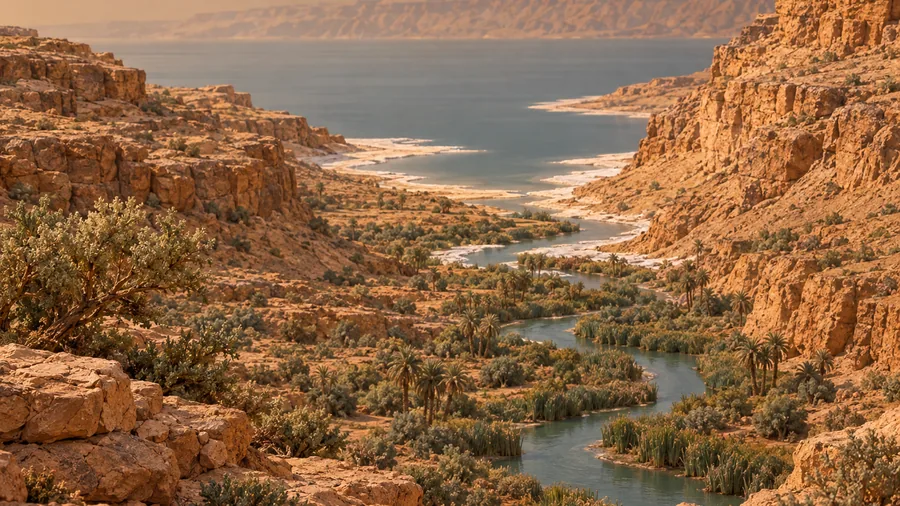
Who Was Nebuchadnezzar? The King of Babylon in the Bible and History
The Bible remembers Nebuchadnezzar as the king who burned Jerusalem and its temple. It also keeps a letter in his name, praising Daniel’s God, the Most High. Who was he, and how did he get from one to the other?
We follow the son of a self-made king from Carchemish to the throne, watch Judah’s last kings answer to him with Babylon’s own Chronicle beside the Bible, walk the city he built, read his three meetings with Daniel’s God from his side, and open the artifact case to see what history and Scripture each say.
Fair on the debates
Where Christians and scholars disagree (here, whether Daniel 4 grew from a later story about Nabonidus, and whether the king’s confession was real faith), we lay out the main views and their reasons and leave the verdict with you.
Transcript
Introduction
0:00This is a brick from Babylon. It’s about twenty-six hundred years old. Before it went into the kiln, someone pressed a stamp into the wet clay: a king’s name, his titles, and his father’s name. Bricks like this turn up all over the ruins of the city.
The king was Nebuchadnezzar. The Bible remembers him as the man who burned Jerusalem and its temple. It also keeps a letter in his name, praising Daniel’s God, the Most High. So who was he? And how did he get from one to the other?
This is Who Was Nebuchadnezzar. By the end, you’ll know three things. How the son of a self-made king became the most powerful man in the world. What he did to Judah, and how his own records line up with the Bible’s. And the three times he met Daniel’s God, told from his side.
The Setting
0:55Let’s start. First, where are we? Babylon, on the Euphrates River, in what’s now Iraq. But when Nebuchadnezzar was a boy, Babylon didn’t rule much of anything. Assyria did, from great cities on the Tigris like Nineveh. In 626 BC, a Babylonian named Nabopolassar took the throne and broke away from Assyria.
In his own inscriptions he calls himself the son of a nobody. With the Medes from the mountains to the east, he went after Assyria itself, and in 612 BC Nineveh fell. Egypt saw its chance. Pharaoh Neco the Second marched north to prop up what was left of Assyria. On the way he killed Judah’s king Josiah. Then he set up a king of his own and renamed him Jehoiakim.
Kings who own you rename you. Here’s the board. Assyria is finished, Egypt is pushing north, and Babylon is rising. Nabopolassar’s eldest son is the crown prince. His Babylonian name was Nabu-kudurri-usur: Nabu, protect my heir. He’s Nebuchadnezzar the Second, because another king had the name about five hundred years before him.
Who’s Who
2:12Let’s meet the cast. Nebuchadnezzar the Second, king of Babylon from 605 to 562 BC. His father, Nabopolassar, who founded the dynasty. Pharaoh Neco the Second of Egypt, his rival for the lands in between. Three of Judah’s last four kings, Jehoiakim, Jehoiachin and Zedekiah, who each had to answer to him. And two Judeans who left us the closest views of him: the prophet Jeremiah, in Jerusalem, and Daniel, inside his own court.
Part one: The crown
2:46Part one: the crown. It’s 605 BC, and Nabopolassar stays home, so the crown prince leads the army. At Carchemish, a river crossing on the upper Euphrates, Nebuchadnezzar meets the Egyptian army and breaks it, then chases the survivors south to Hamath. We know this from the Babylonian Chronicle, a clay tablet now in the British Museum that records his early years, year by year. It claims not a single Egyptian made it home.
Jeremiah remembered the battle too, in the fourth year of King Jehoiakim. Then word comes that his father is dead. By the Chronicle’s dates, Nebuchadnezzar is back in Babylon and on the throne in about three weeks. That same year, the Book of Daniel says, the Lord gave Jehoiakim into his hand, and he took young hostages from Jerusalem’s leading families, Daniel among them, and some of the temple vessels. “He carried these off to the land of Shinar, to the house of his god, where he put them in the treasury of his god.”
From his side, that was most likely a trophy for Marduk, Babylon’s chief god. The Chronicle has him taking the lands west of the Euphrates that year, but it doesn’t name Jerusalem. For that, our source is the Bible.
Part two: The vassals
4:07Part two: the vassals. The Chronicle has him marching west almost every year for tribute. Jehoiakim of Judah submits, and three years later he rebels. Babylon comes back. The Chronicle says that on the second day of the month Adar, the king seized the city of Judah, captured its king, and appointed a king of his own choice.
That’s mid-March, 597 BC, an Old Testament event we can date to the day. Second Kings tells the same story from inside the walls. Jehoiakim has died, and his eighteen-year-old son Jehoiachin surrenders. He goes to Babylon with the temple’s treasures and thousands of Jerusalem’s soldiers and craftsmen.
Nebuchadnezzar puts the young king’s uncle on the throne and renames him Zedekiah. Zedekiah rebels too. This time Jerusalem is besieged for about a year and a half, and in 586 BC the temple is burned. Nebuchadnezzar isn’t even there. He’s at Riblah, in Syria, where Zedekiah is brought to him.
Zedekiah’s sons are killed in front of him, and then his eyes are put out. The Chronicle breaks off before these years, so here the Bible is our main written source. In the ground, Jerusalem’s excavators have found ash, collapsed houses and arrowheads from the fall of the city.
And inside that city, Jeremiah said all of this was God’s judgment on Judah’s sin, and speaking for God to the kings around Judah, he put it in startling words. “So now I have placed all these lands under the authority of My servant Nebuchadnezzar king of Babylon.”
Part three: The builder
5:50Part three: the builder. Between campaigns, Nebuchadnezzar rebuilt Babylon on an enormous scale. Double walls with towers. Palaces by the river. Marduk’s great temple, and beside it the stepped temple tower, the ziggurat, finished in his reign. And the Ishtar Gate, faced with blue-glazed brick, with rows of dragons and bulls in relief, opening onto a processional street lined with lions.
His own building inscriptions describe it all at length, and they sound a lot like what he says on the palace roof in the Book of Daniel. What about the Hanging Gardens? Berossus, a Babylonian priest writing about three centuries later, says he built them for his Median queen, who missed her mountains.
But they’ve never been found at Babylon, and some scholars think the story belongs to Nineveh. So that one stays a tradition.
Part four: The king and Daniel’s God
6:47Part four: the king and Daniel’s God. The Book of Daniel tells of three times he met that God. Read them from the king’s side, and you can watch what he says about Daniel’s God change. In chapter two, he can’t sleep. He doesn’t trust his experts, so he sets them a test: tell me the dream itself, and then I’ll know your meaning is real.
Only a young exile can do it, and the most powerful man in the world falls on his face before him. “Your God is truly the God of gods and Lord of kings, the Revealer of Mysteries, since you were able to reveal this mystery.” But he doesn’t stop there. In chapter three, he sets up a golden statue and orders everyone to bow.
When three men refuse and walk out of the furnace alive, he blesses their God, then decrees that anyone who insults that God will be cut to pieces. He honors their God, and he still rules by decree. Chapter four is different. It’s written as his own letter, to every nation. On his palace roof, he says this. “Is this not Babylon the Great, which I myself have built as a royal residence by the might of my power and for the glory of my majesty?”
He loses his mind and his throne until seven times pass. And then, in his own words: “But at the end of those days I, Nebuchadnezzar, looked up to heaven, and my sanity was restored to me.” He ends the letter like this.
“Now I, Nebuchadnezzar, praise and exalt and glorify the King of heaven, for all His works are true and all His ways are just. And He is able to humble those who walk in pride.”
Behind the Text
8:38So how much of this can we check? Let’s open the artifact case. The Babylonian Chronicle gives us the frame: Carchemish, his crowning, and Jerusalem’s surrender in 597. Then there are the ration tablets. In the storerooms of his palace, excavators found records of oil handed out to foreigners kept at court.
One of the names is Jehoiachin, king of Judah, along with his sons. Second Kings ends with Jehoiachin, decades later, released from prison by Nebuchadnezzar’s son Evil-merodach and eating at the king’s table. Babylonian records know that son as Amel-Marduk. And the madness? No Babylonian record mentions it. The Chronicle’s record breaks off after about 594 BC, and royal inscriptions don’t advertise a king’s weakness, so the silence is hard to read. Many critical scholars date the book of Daniel centuries after Nebuchadnezzar, and think Daniel 4 grew from a story about a later king, Nabonidus, because a text among the Dead Sea Scrolls, the Prayer of Nabonidus, has him struck by illness for seven years at Tema and helped by a Jewish exile.
Conservative scholars, who hold that Daniel wrote in the 6th century BC, answer that the two differ in the illness, the place and the helper, and that the Prayer is the later text, so a shared source is far from certain. With the records we have, history can’t settle it. Here’s what we do know.
Nebuchadnezzar died in 562 BC, after forty-three years on the throne. The empire he built lasted twenty-three years more.
Where It Points
10:17So who was Nebuchadnezzar? A brilliant general, a tireless builder, and a brutal conqueror. And by the Bible’s account, the servant God used, and the proud man God humbled. Was his confession real faith? Christians read it more than one way. Some read it as a true conversion. Others read it as a king who honored Israel’s God as the highest while Babylon’s gods stayed.
The letter doesn’t settle it. But the line he ends on runs through the whole Bible. Mary sings the same truth in Luke, before Jesus is born. “He has brought down rulers from their thrones, but has exalted the humble.”
Nebuchadnezzar reached for glory and God brought him low. Paul tells of Jesus, who already had the glory and humbled himself by choice: “He humbled Himself and became obedient to death—even death on a cross.” And then God exalted him.
One Thing to Remember
11:17If you remember one thing about Nebuchadnezzar, make it this. The most powerful king on earth was never the one really in charge, and he said so himself, at the top of his letter. “His kingdom is an eternal kingdom; His dominion endures from generation to generation.”
Next time
11:41That’s Nebuchadnezzar. To see the same years from Daniel’s side, watch the Book of Daniel. Next time, we’ll look at the land itself, the stage for the whole Bible. Thanks for spending this time with me.
Sources and further reading
Babylon’s own records: A. K. Grayson, Assyrian and Babylonian Chronicles (Chronicles 2, 3 and 5); D. J. Wiseman, Chronicles of Chaldaean Kings; R. Da Riva, The Inscriptions of Nabopolassar, Amel-Marduk and Neriglissar; R. A. Parker and W. H. Dubberstein, Babylonian Chronology; the Jehoiachin ration tablets (E. F. Weidner, 1939; ANET).
The king and his city: D. J. Wiseman, Nebuchadrezzar and Babylon; Paul-Alain Beaulieu, A History of Babylon, 2200 BC–AD 75; Robert Koldewey, The Excavations at Babylon; Irving Finkel and Michael Seymour, Babylon: Myth and Reality.
The Hanging Gardens: Berossus, via Josephus, Against Apion 1.19–20 and Antiquities 10.11.1; Stephanie Dalley, The Mystery of the Hanging Garden of Babylon (the Nineveh proposal).
Jerusalem’s fall in the ground: Yigal Shiloh, Excavations at the City of David I; Nahman Avigad, Discovering Jerusalem.
Daniel 4 and the Prayer of Nabonidus, both views: critical, John J. Collins, Daniel (Hermeneia) and his edition of 4Q242 (DJD 22); conservative, Stephen R. Miller, Daniel (New American Commentary), Andrew E. Steinmann, Daniel (Concordia Commentary), and Joyce G. Baldwin, Daniel (Tyndale).
Daniel 1:1 (third year) and Jeremiah 46:2 (fourth year): Miller; Steinmann; Edwin R. Thiele, The Mysterious Numbers of the Hebrew Kings.
Map data
Terrain: NOAA NCEI ETOPO 2022 (doi:10.25921/fd45-gt74). Coastlines and rivers: Natural Earth. Place locations: OpenBible.info Bible Geocoding Data, CC BY 4.0.
Photo credits
Real museum photographs, cropped for this video; the crops carry the same licenses as the originals.
- Stamped brick of Nebuchadnezzar II, from Babylon: photo by Osama Shukir Muhammed Amin FRCP(Glasg), CC BY-SA 4.0. commons.wikimedia.org/?curid=72501447
- The Babylonian Chronicle of Nebuchadnezzar’s early years, British Museum: photo by Osama Shukir Muhammed Amin FRCP(Glasg), CC BY-SA 4.0. commons.wikimedia.org/?curid=122830389
- The same Chronicle: photo by Jona Lendering (Livius.org), CC0. commons.wikimedia.org/?curid=87909002
- Dragon and aurochs from the Ishtar Gate, Pergamon Museum, Berlin: photo by Osama Shukir Muhammed Amin FRCP(Glasg), CC BY-SA 4.0. commons.wikimedia.org/?curid=90765136
- Lion from the Processional Way, Babylon: photo by Gary Todd, CC0. commons.wikimedia.org/?curid=101242236
- East India House Inscription, British Museum: photo by Szilas, CC BY-SA 4.0. commons.wikimedia.org/?curid=129744668
- Ration tablet naming Jehoiachin of Judah, and a detail, Vorderasiatisches Museum, Berlin: photos by Scallaham, CC BY-SA 4.0. commons.wikimedia.org/?curid=45511871 and commons.wikimedia.org/?curid=141528842
How this is made
Map & Lamp is animated in a handmade clay style. The story scenes are made with AI image and video tools, directed shot by shot; the maps are built in Blender from real terrain data and labeled by hand in After Effects. Scripts are drafted with AI assistance, sourced to named works, checked against the text, and reviewed and approved by the creator before release. The narration is the creator’s own voice, produced with a voice model made from his recordings. Music and sound effects are licensed library recordings, not AI-generated.
Spot something we got wrong? Write to [email protected].