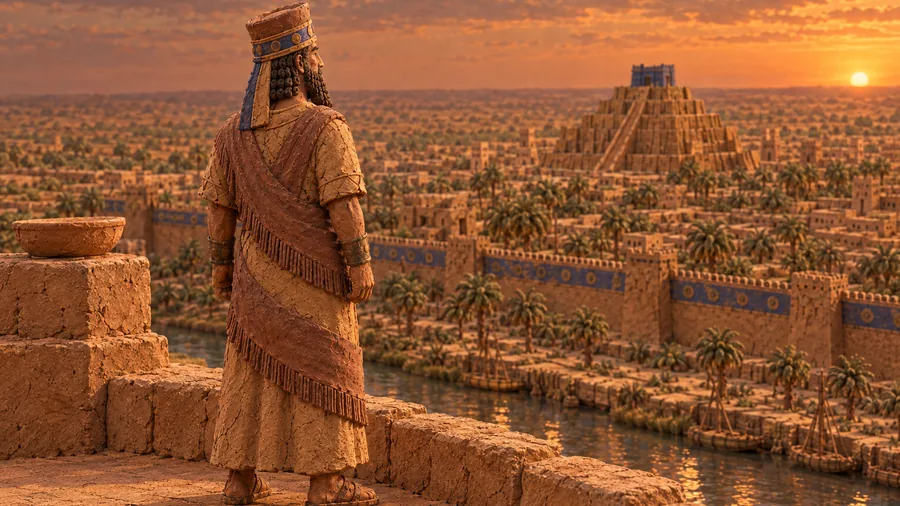
The Book of Daniel Explained: Babylon, Four Kingdoms & the Lions’ Den
According to the book, a young man, probably still a teenager, is marched from Jerusalem to the capital of the world’s superpower, and is still there when the empire falls. This is the Book of Daniel, set on the map.
Daniel asks one question in every chapter: when empires own the world, who really rules it? We set the scene, walk through the six stories of Daniel 1–6 and the visions of 7–12 (with the two main readings of the four kingdoms), open the artifact case, and follow the book to Jesus’s trial.
Fair on the debates
Where Christians and scholars disagree (here, the four kingdoms, the seventy weeks and the book’s date), we lay out the main views and their reasons and leave the verdict with you.
Transcript
Introduction
0:00It’s 605 BC. A Babylonian army has come to Jerusalem. And now a line of young men from Judah’s best families is being marched east, away from home. They’re bright, well educated, quick to learn. One of them is probably still a teenager.
His name is Daniel. He’ll spend most of his life in the capital of the most powerful empire on earth. He’ll serve its kings. And he’ll still be there, an old man, on the night that empire falls. So here’s the question this book keeps asking.
When empires own the world, who really rules it? This is the Book of Daniel. By the end of this video, you’ll know three things. How Judah ended up in Babylon. What Daniel’s famous stories and his strange visions are really about. And why Jesus, on trial for his life, answered with words from this book.
The Setting
0:57Let’s open it up. First, where are we? Babylon sat on the Euphrates River, in southern Mesopotamia. Today that’s Iraq, south of Baghdad. To get there from Jerusalem, you didn’t cross the desert. You went the long way, north and then east, around the curve of good land we call the Fertile Crescent. That’s roughly 900 miles.
More than a century later, a group led by Ezra made that trip, and it took them about four months. Now, when? The fall of Judah came in three blows. The first was 605 BC. Babylon’s army, led by Nebuchadnezzar, beat Egypt at a place called Carchemish, on the upper Euphrates.
Babylon’s own records tell us that. The Book of Daniel picks up from there: Nebuchadnezzar comes to Jerusalem and carries off young men from Judah’s royal family and nobles. Daniel is one of them. The second blow came in 597 BC.
Jerusalem was captured, and the young king Jehoiachin was taken to Babylon with thousands of his people. A priest named Ezekiel went with them. The third came in 586 BC, when the city and Solomon’s temple were burned. Many scholars date that a year earlier, to 587. Who’s in power? Babylon, under Nebuchadnezzar the Second, the superpower of its day. So here’s the situation. Judah has lost its king, its city, and its temple. God’s people are living inside a foreign empire.
And hold on to one more date. In 539 BC, Persia, under a king named Cyrus, takes Babylon. According to the book, Daniel is still there.
Who’s Who
2:39Before the stories, let’s meet the cast. Daniel. His Hebrew name means God is my judge. In Babylon he’s given a new name, Belteshazzar. His three friends, Hananiah, Mishael and Azariah. You probably know them by their Babylonian names: Shadrach, Meshach and Abednego.
Nebuchadnezzar the Second, king of Babylon from 605 to 562 BC, and the king who shapes Daniel’s early life. Belshazzar, ruling as king in Babylon for his father, Nabonidus. There’s a story there, and we’ll come back to it. And the handover to Persia: Darius the Mede and Cyrus the Persian. Darius is a puzzle of his own, and we’ll get to him too.
Daniel 1: Faithful in a foreign court
3:23Chapter one. The four friends are enrolled in the king’s school: three years of the language and literature of Babylon, new names, and food from the king’s own table. And here Daniel draws a line. “But Daniel made up his mind that he would not defile himself with the king’s food or wine.” He doesn’t make a scene. He asks for a test: ten days of vegetables and water, then compare. At the end of ten days, the four look healthier than everyone else, and the book says God gave them knowledge and understanding.
Why would the king’s food defile him? The book doesn’t say. Some point to the food laws in the Law of Moses, some to food offered to Babylon’s gods, and some to a quiet refusal to depend on the king. Whatever the reason, the theme of the whole book is set. Daniel doesn’t run from Babylon. He serves in it, faithfully, without belonging to it.
Daniel 2: The king’s dream
4:23Chapter two. Nebuchadnezzar has a dream that troubles him, and he makes an impossible demand. His wise men must tell him the dream itself, not just what it means. If they can’t, they die. They can’t. So Daniel and his friends do the one thing they can do. They pray.
And that night, God shows Daniel the dream. Here it is. A huge statue. A head of gold. A chest and arms of silver. A belly and thighs of bronze. Legs of iron. And feet of iron mixed with clay.
Then a stone, cut out but not by human hands, strikes the statue on its feet. The whole thing shatters and blows away like chaff. And the stone becomes a great mountain that fills the whole earth. Daniel explains it. The king himself is the head of gold. After him come three more kingdoms. And then this.
“the God of heaven will set up a kingdom that will never be destroyed, nor will it be left to another people. It will shatter all these kingdoms and bring them to an end, but will itself stand forever.” Notice what the book does and doesn’t tell us. It names the first kingdom, Babylon.
It doesn’t name the other three. So which four kingdoms are these? Hold that question. The book comes back to it, and so will we.
Daniel 3: The fiery furnace
5:54Chapter three. Nebuchadnezzar sets up a golden statue on the plain of Dura, sixty cubits high, about ninety feet. When the music plays, everyone must bow down. Three men stay on their feet, and Shadrach, Meshach and Abednego give the king one of the bravest answers in the Bible. “He is able to deliver us from the blazing fiery furnace and from your hand, O king. But even if He does not, let it be known to you, O king, that we will not serve your gods or worship the golden statue you have set up.”
Into the furnace they go. Then the king looks in and sees four men walking in the fire, and he says “the fourth looks like a son of the gods”. Christians read that fourth figure two ways: as an angel, which is what the king himself calls him afterward, or as the Son of God appearing before his birth. Older translations, like the King James, read the Son of God there.
Daniel 4: The king humbled
6:56Chapter four is framed as the king’s own letter. He dreams of a great tree cut down. A year later he stands on his palace roof and boasts about the Babylon he built. He loses his mind and lives like an animal for seven periods of time, until he learns what the dream had said: “the Most High rules over the kingdom of mankind and gives it to whom He wishes”.
Daniel 5: The writing on the wall
7:23Chapter five jumps ahead to 539 BC, Babylon’s last night. The Persian army is outside. Inside, King Belshazzar throws a feast, and they drink from the gold and silver cups taken from the temple in Jerusalem. Then the fingers of a human hand write on the plaster of the wall. Daniel is brought in, an old man now, around eighty by our best estimate.
The words mean numbered, weighed, divided, and he doesn’t soften them. “you have been weighed on the scales and found deficient.” That very night Belshazzar is killed, and Darius the Mede receives the kingdom. Greek historians later said the Persians got in by diverting the river. That’s their account; Daniel doesn’t say how.
Daniel 6: The lions’ den
8:12Chapter six. Under Darius, jealous officials can’t find a fault in Daniel, so they use his faith. The king signs a decree: for thirty days, pray to no one but the king. Daniel goes home to his upper room, with its windows open toward Jerusalem, and “three times a day he got down on his knees, prayed, and gave thanks to his God, just as he had done before.”
He’s thrown to the lions, and the stone is sealed. At dawn the king runs to the den. Daniel is alive. God sent his angel and shut the lions’ mouths. There’s a hard verse here, and we won’t skip it. The king orders Daniel’s accusers thrown in, with their families.
The book reports that as the king’s order, not God’s command. The chapter ends with Darius praising Daniel’s God, and Daniel prospering under Darius and Cyrus.
Daniel 7–12: The visions
9:08With chapter seven, the book turns from stories to visions, and steps back in time. Four beasts rise from a churning sea: a lion with eagle’s wings, a bear, a four-headed leopard, and a fourth beast with iron teeth and a boasting little horn.
The Ancient of Days takes his seat on a throne of fire. And then, “I saw One like the Son of Man coming with the clouds of heaven. … And He was given dominion, glory, and kingship … His kingdom is one that will never be destroyed.”
The vision explains itself. The beasts are “four kings who will arise from the earth.” Chapter eight adds a ram, Media and Persia, and a goat, Greece. The goat’s great horn breaks into four, which fits Alexander the Great and the kingdoms that split his empire. Then a small horn grows.
Most readers, of every kind, see Antiochus the Fourth there, a Greek king who persecuted the Jews, and many also see a pattern of a later figure. So which four kingdoms? Readers land in two main places. One reading: Babylon, Medo-Persia, Greece, and Rome, the historic majority view, held across evangelical traditions today.
It notes that chapter eight makes Media and Persia one ram, so Greece comes third. The other: Babylon, Media, Persia, and Greece, the majority critical view, held by some conservatives too. It notes that chapter eight’s small horn mirrors chapter seven’s little horn. In chapter nine, after a long prayer, Gabriel brings Daniel a message of seventy weeks, literally seventy sevens. Many read it as fulfilled in Christ’s first coming.
Dispensational readers see it fulfilled in Christ, with the seventieth week still future. Most critical scholars see it fulfilled under Antiochus. It gets its own episode. The last chapters trace kings of the north and south, broadly agreed through chapter eleven, verse thirty-five; after that, readers see Antiochus again, or a figure still to come.
And then, the Old Testament’s clearest promise of resurrection. “And many who sleep in the dust of the earth will awake, some to everlasting life, but others to shame and everlasting contempt.”
Behind the Text
11:34Let’s open the artifact case. For centuries, Belshazzar was known almost only from the Book of Daniel, and critics counted that against the book. Then cuneiform texts turned up naming him as the eldest son of Nabonidus, the last king of Babylon.
Nabonidus spent about ten years at the oasis of Tema, in Arabia, while his son ran Babylon. That’s the usual explanation for why Belshazzar can offer Daniel only the third place in the kingdom. His father held the first. Others read third as an official rank, like the three administrators in chapter six. And when the book calls Nebuchadnezzar his father, critics call that a mistake. But in the ancient world, father could mean ancestor or royal predecessor.
An Assyrian monument, the Black Obelisk, calls King Jehu the son of Omri, though Jehu ended Omri’s dynasty. There, son means a later king, not a descendant. Then there’s Darius the Mede. No text outside the Bible names him yet. Scholars have proposed Gubaru, a governor Cyrus set over Babylon; Cyrus himself, reading chapter six, verse twenty-eight as Darius, that is, Cyrus; and Cyaxares the Second, from the Greek writer Xenophon. Most critical scholars see him as a literary figure, because the book’s Median kingdom between Babylon and Persia matches no known reign.
The honest answer is, we don’t know for sure. Here’s something an English Bible hides. Daniel is written in two languages. It opens in Hebrew. Then, in chapter two, when the court speaks to the king, it switches to Aramaic, the common language of the empire, and stays there through chapter seven. Chapters eight to twelve return to Hebrew. The scholar Lenglet pointed out that chapters two to seven form a mirror: four kingdoms in two and seven, rescues in three and six, proud kings judged in four and five.
Stories for the nations, in the nations’ language. Ezra also switches to Aramaic, for imperial documents. Last, when was Daniel written? The book presents itself as Daniel’s, from the sixth century BC, and that’s the frame we’ve used. Most critical scholars date it to about 165 BC, during the persecution under Antiochus. Their strongest point is chapter eleven, which follows his reign in close detail up to about that year. Many hold the late date because they believe detailed prediction can’t happen, but not all.
Some evangelical scholars, John Goldingay among them, hold it because they read the visions as a kind of writing that looks back while speaking forward. Each side points to evidence: the style of the Aramaic, a few Greek words for musical instruments in chapter three, and the copies of Daniel among the Dead Sea Scrolls, the oldest made not long after 165 BC. Jesus spoke of “the prophet Daniel”. Scholars on both sides answer each of these points, and the sources for both are in the description.
Where It Points
14:35So, back to our question. When empires own the world, who really rules it? Daniel’s answer is the same in every chapter. Empires rise and fall on God’s timetable, and the kingdom that lasts is the one given in chapter seven. The New Testament picks up that thread.
Son of Man is the name Jesus used most for himself. At his trial, the high priest asks if he is the Christ. Jesus answers with words from Daniel 7 and Psalm 110. “I am … and you will see the Son of Man sitting at the right hand of Power and coming with the clouds of heaven.”
The high priest tears his clothes and calls it blasphemy. The usual explanation is that Jesus was claiming to share God’s throne. And Gabriel, who explains two of Daniel’s visions, announces the births of John the Baptist and of Jesus.
And Daniel’s promise that the dead will rise is the hope Jesus takes up, when he says that “all who are in their graves will hear His voice” and come out. Christians have also long seen the stone cut out without hands as the kingdom Jesus brings.
And to be fair to the text, Daniel 7 also gives the kingdom to God’s people: “the saints of the Most High will receive the kingdom”. The New Testament holds both together. The King, and his people.
One Thing to Remember
16:01If you remember one thing from Daniel, make it this. Kingdoms rise and fall on God’s timetable, and his kingdom is the one that lasts. Here’s how Daniel put it, the night God showed him the king’s dream. “Blessed be the name of God forever and ever, for wisdom and power belong to Him.
He changes the times and seasons; He removes kings and establishes them.”
Next time
16:31That’s the Book of Daniel. Next time, we’ll look at the land itself, the stage for the whole Bible. And if you want more on the king who took Daniel to Babylon, watch Who Was Nebuchadnezzar. Thanks for spending this time with me. I’ll see you in the next book.
Sources and further reading
When was Daniel written? Both views, as promised in the video:
- Sixth century BC: K. A. Kitchen, On the Reliability of the Old Testament; Stephen R. Miller, Daniel (New American Commentary); Andrew E. Steinmann, Daniel (Concordia Commentary)
- About 165 BC: John J. Collins, Daniel (Hermeneia); John E. Goldingay, Daniel (Word Biblical Commentary)
- Both laid out: Tremper Longman III and Raymond B. Dillard, An Introduction to the Old Testament
Commentaries: Joyce G. Baldwin, Daniel (Tyndale); Ernest C. Lucas, Daniel (Apollos); Tremper Longman III, Daniel (NIVAC); John F. Walvoord, Daniel.
The four kingdoms and the seventy weeks: Rome reading, Miller, Steinmann and Walvoord (above); Greece reading, R. J. M. Gurney, “The Four Kingdoms of Daniel 2 and 7” (Themelios), and a variant of it, John H. Walton, “The Four Kingdoms of Daniel” (JETS); seventy weeks, Harold W. Hoehner, Chronological Aspects of the Life of Christ.
History and ancient texts: A. K. Grayson, Assyrian and Babylonian Chronicles (incl. the Nabonidus Chronicle); D. J. Wiseman, Nebuchadrezzar and Babylon; Paul-Alain Beaulieu, The Reign of Nabonidus; John C. Whitcomb, Darius the Mede; Herodotus, Histories 1.191; Xenophon, Cyropaedia 7.5; A. Lenglet, “La structure littéraire de Daniel 2–7” (Biblica 53); the Qumran Daniel scrolls in the Leon Levy Dead Sea Scrolls Digital Library (deadseascrolls.org.il).
Map data
Terrain: NOAA NCEI ETOPO 2022 (doi:10.25921/fd45-gt74). Coastlines and rivers: Natural Earth. Place locations: OpenBible.info Bible Geocoding Data, CC BY 4.0.
Photo credits
Real museum photographs, cropped for this video; the crops carry the same licenses as the originals.
- Nabonidus Cylinder from Ur, British Museum: photo © Marie-Lan Nguyen / Wikimedia Commons, CC BY 2.5. commons.wikimedia.org/?curid=2603466
- Nabonidus Chronicle, British Museum: photo by Osama Shukir Muhammed Amin FRCP(Glasg), CC BY-SA 4.0. commons.wikimedia.org/?curid=122825826
- Black Obelisk of Shalmaneser III, British Museum: photo by Gary Todd, CC0. commons.wikimedia.org/?curid=87554027
- Jehu before Shalmaneser III, Black Obelisk panel: photo by Steven G. Johnson, CC BY-SA 3.0. commons.wikimedia.org/?curid=87388860
- Ration tablet naming Jehoiachin of Judah (detail), Vorderasiatisches Museum, Berlin: photo by Scallaham, CC BY-SA 4.0. commons.wikimedia.org/?curid=141528842
- Tetradrachm of Antiochus IV, Staatliche Münzsammlung München: photo by ArchaiOptix, CC BY-SA 4.0. commons.wikimedia.org/?curid=98119380
How this is made
Map & Lamp is animated in a handmade clay style. The story scenes are made with AI image and video tools, directed shot by shot; the maps are built in Blender from real terrain data and labeled by hand in After Effects. Scripts are drafted with AI assistance, sourced to named works, checked against the text, and reviewed and approved by the creator before release. The narration is the creator’s own voice, produced with a voice model made from his recordings. Music and sound effects are licensed library recordings, not AI-generated.
Spot something we got wrong? Write to [email protected].