Why Did Jonah Run? The Book of Jonah Explained
God sends a prophet to the great city of the people his nation feared most, and he books a ship the other way. Prophets in the Bible argue with God. This one runs. Why would a prophet run from God, and why does his book end with a question nobody answers?
We put Jonah on the map in the days of Jeroboam the Second, meet the cast, follow the whole book from the storm to the shade in four short chapters, hear Jonah say in his own words why he ran, open the evidence on the man, the city and the repentance, and follow the sign Jesus drew from him.
Fair on the debates
Where Christians and scholars differ (here, whether the book is history or a story told to teach, and how to read Nineveh’s three-day journey), we lay out the main views and their reasons. This video tells Jonah as history, the way Jesus refers to it, and says so.
Transcript
Introduction
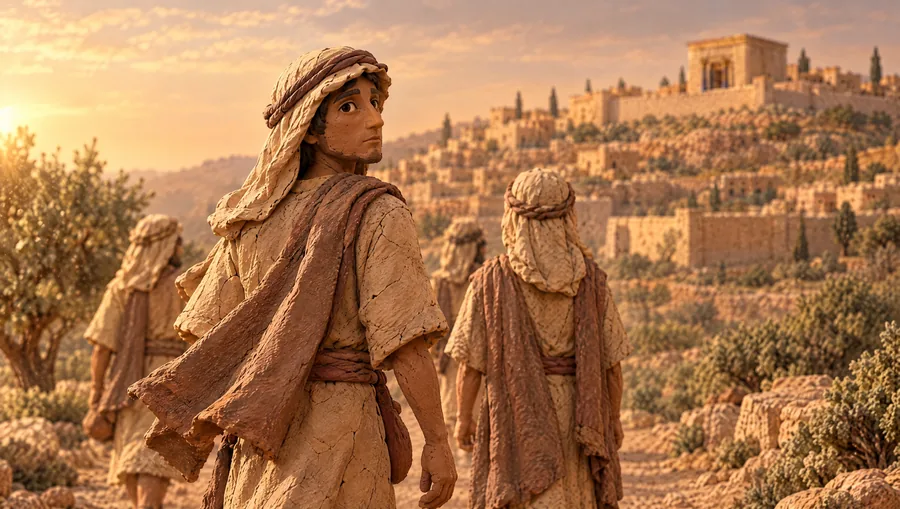
0:00This is Joppa, a small harbor on the coast of Israel. A man walks down to the quay, finds a ship, and pays his fare. He isn’t a merchant. He’s a prophet. God had told him to get up and go east, to Nineveh, the great city of the people his nation feared most.
This ship is sailing west, as far from Nineveh as a ship would take him. He chose it on purpose. Prophets in the Bible argue with God. They complain, they plead, they ask why. This one runs. Why would a prophet run from God? And why does his book end with a question nobody answers?
This is the Book of Jonah. By the end, you’ll know three things. Who Jonah was, and why Nineveh frightened Israel. The whole book, from the storm to the shade, in four short chapters. And why Jonah really ran, in his own words, and why Jesus pointed back to him.
The Setting
1:00Let’s start. First, where are we, and when? Outside his own book, the Old Testament mentions Jonah in one place, in Second Kings. It calls him “His servant Jonah son of Amittai, the prophet from Gath-hepher.” Gath-hepher is a village in the hills of Galilee, in the northern kingdom of Israel.
The king is Jeroboam the Second, in the first half of the 700s BC. Jonah’s earlier word was good news for Israel: its old borders would come back. They did. Now look east. Past the desert, on the Tigris River, is Assyria, and one of its great cities is Nineveh.
Assyria is the great power of the east, and Israel already knows its reach. A couple of generations earlier, King Jehu of Israel paid tribute to an Assyrian king, and the Assyrians carved the scene in stone. Within a few decades of Jonah, Assyria will carry the northern kingdom away.
Assyria was famous for its cruelty to the cities that resisted it, and it said so in its own records. So here’s the map of Jonah’s choice. Nineveh is more than five hundred miles to the east, overland. Joppa is on the coast to the west. And Tarshish, where his ship is bound?
Nobody knows for sure where it was. The Bible pairs it with ships and long voyages. On our table, it’s simply off the edge.
Who’s Who
2:29Let’s meet the cast. Jonah, son of Amittai, a prophet from Galilee. His name means dove. The sailors and their captain, each crying out to his own god. The king of Nineveh, whom the book never names. And the people of Nineveh, more than a hundred and twenty thousand of them. Above them all is the one the book never shows, only hears: the God who speaks first in this book, and has the last word.
Part one: The storm
3:00Part one: the storm. The book opens with God’s word to Jonah: get up, go to the great city of Nineveh, and preach against it, because its wickedness has come up before him. And Jonah gets up, to run. Watch the direction the story keeps taking him. He goes down to Joppa. He goes down into the ship.
Then he goes down into the lowest part of the hold and falls asleep. Then “the LORD hurled a great wind upon the sea”, and the ship starts to break apart. The sailors are terrified. Each one cries out to his own god, and they throw the cargo overboard.
The captain finds Jonah asleep and wakes him. Call on your god, he says. Maybe your god will spare us. The sailors cast lots, and the lot falls on Jonah. Who are you, they ask, and where are you from?
His answer is the strangest line on the ship. “I worship the LORD, the God of the heavens, who made the sea and the dry land.” He’s running from the God who made the sea, on the sea. Jonah tells them to throw him overboard. They try to row for land instead, and they can’t. So these sailors, who started the night praying to their own gods, pray to the LORD, and they ask him not to hold this man’s life against them.
They throw Jonah into the sea, and the sea goes calm. And the sailors fear the LORD, offer a sacrifice, and make vows to him. The first people in this book to call on the LORD by name aren’t Israelites.
Part two: The fish
4:37Part two: the fish. The book says it in one sentence. “Now the LORD had appointed a great fish to swallow Jonah, and Jonah spent three days and three nights in the belly of the fish.” Notice the word appointed.
It comes back three more times before the end. The Hebrew doesn’t say what kind of creature it was, only that it was great. And from inside the fish, Jonah prays. It reads less like a cry for rescue and more like a psalm of thanks, spoken as though the rescue were already given.
“In my distress I called to the LORD, and He answered me.” He describes going down again, all the way down: the deep, the seaweed around his head, the roots of the mountains. Then God brings him up. The prayer ends with the line the whole book turns on, and we’ll come back to it. Then God speaks to the fish, and it puts Jonah out on dry land.
Part three: The city turns
5:39Part three: the city. God’s word comes to Jonah a second time, almost the same words. Get up, go to Nineveh. This time, he goes. The book says, “Now Nineveh was an exceedingly great city, requiring a three-day journey.” Readers take that in more than one way: three days to cross the whole district around the city, or three days to visit it properly.
Either way, this is a big place, and Jonah walks in alone. His whole message, as the book records it, is this: “Forty more days and Nineveh will be overturned!” In Hebrew that’s just five words. And the word for overturned can also mean turned around.
Which one will Nineveh be? The people of Nineveh believe God. They call a fast, and everyone, from the greatest to the least, puts on sackcloth. When the news reaches the king, he gets off his throne, takes off his robe, puts on sackcloth, and sits in ashes.
He orders that no one eat or drink, people or animals, that everyone call out to God, and turn from their violence. And he says, “Who knows? God may turn and relent; He may turn from His fierce anger, so that we will not perish.”
And God sees what they do, how they turn from their evil ways, and he relents from the disaster he had threatened. Nineveh was turned around.
Part four: The question
7:11Part four: the question. You’d expect the book to end there, with the greatest revival a prophet ever saw. Instead, Jonah is furious. And now, finally, he tells us why he ran in the first place. He prays, and he says, “I knew that You are a gracious and compassionate God, slow to anger, abounding in loving devotion—One who relents from sending disaster.”
That echoes what God said about himself to Moses at Mount Sinai. By his own account, Jonah ran because he knew God would forgive them. He asks God to take his life. And God answers with a question. “Have you any right to be angry?”
Jonah doesn’t answer. He walks out of the city, sits down on its east side, builds himself a little shelter, and waits to see what will happen to Nineveh. Then God appoints three more things. A vine, that grows up over Jonah’s head and gives him shade, and Jonah is very glad of it. A worm, at dawn the next day, that attacks the vine until it withers. And a scorching east wind, with the sun beating down, until Jonah is faint and says again that he’d rather die.
And then God has the last word. You cared about this plant, he says, which you didn’t plant or grow. It came up in a night, and it died in a night. “So should I not care about the great city of Nineveh, which has more than 120,000 people who cannot tell their right hand from their left, and many cattle as well?”
That’s where the book ends. With a question. We never hear Jonah’s answer.
Behind the Text
8:54So what can we check? Start with Jonah himself. Second Kings ties him to a real king, Jeroboam the Second, and to a real village, Gath-hepher. Its likely site is in the Galilee hills, only a few miles from Nazareth.
Then the city. Nineveh’s ruins are two great mounds on the Tigris, across the river from today’s Mosul. Explorers dug there in the 1840s and found palaces lined with carved stone panels. One of the mounds carries the name Nebi Yunus, the prophet Jonah, after a shrine there that tradition held to be his tomb.
What about the repentance? The Assyrian records we have don’t mention Jonah, or a citywide fast. That’s not surprising: Assyrian kings wrote about their victories, not their fears. Some historians point out that the mid-700s were a shaky time for Assyria, with revolts, outbreaks of plague, and a solar eclipse recorded in 763 BC, the kind of years when a warning might land. That’s a possible backdrop, not proof, and the book doesn’t name the king or the year.
And is the book history or a parable? Most Christians through the centuries have read it as history, and Jesus speaks of Jonah and Nineveh as real. Some readers, Christians among them, take it as a story told to teach, because of how carefully it’s built and how it ends on a question. This video tells it as history, as Jesus speaks of it. Whichever way you read it, the book ends by turning its question on the reader.
Where It Points
10:29So why did Jonah run? Not because God was harsh, but because he was merciful, and Jonah didn’t want that mercy for his enemies. The book leaves his answer blank, so the question passes to us. Nearly eight hundred years later, people asked Jesus for a sign, and he pointed them to Jonah. “For as Jonah was three days and three nights in the belly of the great fish, so the Son of Man will be three days and three nights in the heart of the earth.”
And he added that the people of Nineveh had turned at Jonah’s preaching, “and now One greater than Jonah is here.” Jonah went down and came back up. Jesus pointed to his own death and rising as the greater sign.
One Thing to Remember
11:15If you remember one thing about Jonah, make it this. God’s mercy reaches further than his own prophet wanted it to. Jonah said it himself, from the bottom of the sea. “Salvation is from the LORD!”
Next time
11:34That’s Jonah. Next time, the city he was sent to: Nineveh, its kings, and its fall. If you’re new here, start with The Land, the map behind every book. Thanks for spending this time with me.
Sources and further reading
The text: Jonah 1–4; 2 Kings 14:25 (Jonah son of Amittai, Gath-hepher, Jeroboam the Second); Exodus 34:6 (the words Jonah echoes in 4:2); Matthew 12 (verses 39–41) and Luke 11 (verses 29–32), the sign of Jonah.
The book of Jonah: Jack M. Sasson, Jonah (Anchor Bible); T. Desmond Alexander, Jonah (Tyndale Old Testament Commentaries); Douglas Stuart, Hosea–Jonah (Word Biblical Commentary).
Assyria and Nineveh: Amélie Kuhrt, The Ancient Near East; Austen Henry Layard, Nineveh and Its Remains; A. R. Millard, The Eponyms of the Assyrian Empire (the eclipse of 763 BC); the Black Obelisk of Shalmaneser III, British Museum.
The land and the dates: Yohanan Aharoni, The Land of the Bible; Edwin R. Thiele, The Mysterious Numbers of the Hebrew Kings; K. A. Kitchen, On the Reliability of the Old Testament.
Map data
Terrain: NOAA NCEI ETOPO 2022 (doi:10.25921/fd45-gt74). Coastlines and rivers: Natural Earth. Place locations: OpenBible.info Bible Geocoding Data, CC BY 4.0.
Photo credits
Real museum photographs, cropped for this video; the crops carry the same licenses as the originals.
- The Black Obelisk of Shalmaneser III, the panel naming Jehu of Israel, from Nimrud, British Museum: photo by Osama Shukir Muhammed Amin FRCP(Glasg), CC BY-SA 4.0. commons.wikimedia.org/?curid=72917922
- Horses from Ashurbanipal’s lion-hunt reliefs, North Palace at Nineveh, British Museum: photo by Osama Shukir Muhammed Amin FRCP(Glasg), CC BY-SA 4.0. commons.wikimedia.org/?curid=105633760
How this is made
Map & Lamp is animated in a handmade clay style. The story scenes are made with AI image and video tools, directed shot by shot; the maps are built in Blender from real terrain data and labeled by hand in After Effects. Scripts are drafted with AI assistance, sourced to named works, checked against the text, and reviewed and approved by the creator before release. The narration is the creator’s own voice, produced with a voice model made from his recordings. Music and sound effects are licensed library recordings, not AI-generated.
Spot something we got wrong? Write to [email protected].